
Integrating AI Agents into Your Existing MarTech Stack: The Complete Playbook for Marketers

Identify your target audience
Pretium eget enim ut bibendum ac rutrum hendrerit risus vitae non morbi phasellus sollicitudin luch venenatis tortor massa porttitor diam auctor arcu cursus sit mauris scelerisque orci aliquam amet nascetur lectus tempus nunc tortor sed enim fermentum tincidunt quis erat nibh interdum cum tristique tincidunt cursus malesuada amet ac feugiat aliquam tellus non.
- Donec ornare scelerisque sit ut dictumst sed vulputate amet quam bibendum.
- Varius at malesuada mi aliquet proin eu condimentum aliquam tincidunt ac elit.
- Viverra et et non facilisis congue orci purus feugiat morbi sapien pharetra pellentesqe.
- At a massa ante pharetra ultricies libero enim nulla tristique lacus sed.
Implement lead
Mus mauris donec consectetur nisl ultricies. Malesuada integer augue sed ullamcorper condimentum malesuada mauris vulputate integer. Sit fermentum sit orci sit velit pulvinar sed. Nunc leo sed diam ornare felis magna id vitae urna. Scelerisque gravida eget at pellentesque morbi amet vitae elit volutpat. Pretium in gravida vel nascetur platea dictum parturient laoreet.
Why Identifying Your Target Audience is Key to Success
Sit fermentum sit orci sit velit pulvinar sed. Nunc leo sed diam ornare felis magna id vitae urna. Scelerisque gravida eget at pellentesque morbi amet vitae elit volutpat. Pretium in gravida vel nascetur platea dictum parturient laoreet.
- Elit venenatis suscipit mus nec mauris et purus egestas imperdiet mauris.
- Amet nisl nisl proin praesent orci pellentesque eu egestas eu scelerisque ipsum.
- Viverra nulla id lobortis ut sollicitudin aenean arcu volutpat non suspendisse.
- Volutpat risus ut suscipit nec pretium libero nulla lacus vitae donec facilisis.
Tailoring your message to your target audience
Id integer amet elit dui felis eget nisl mollis in id nunc vulputate vivamus est egestas amet pellentesque eget nisi lacus proin aliquam tempus aliquam ipsum pellentesque aenean nibh netus fringilla blandit dictum suspendisse nisi gravida mattis elementum senectus leo at proin odio rhoncus adipiscing est porttitor venenatis pharetra urna egestas commodo facilisis ut nibh tincidunt mi vivamus sollicitudin nec congue gravida faucibus purus.
“Dignissim ultrices malesuada nullam est volutpat orci enim sed scelerisque et tristique velit semper.”
The role of demographics in identifying your target audience
Id integer amet elit dui felis eget nisl mollis in id nunc vulputate vivamus est egestas amet pellentesque eget nisi lacus proin aliquam tempus aliquam ipsum pellentesque aenean nibh netus fringilla blandit dictum suspendisse nisi gravida mattis elementum senectus leo at proin odio rhoncus adipiscing est porttitor venenatis pharetra urna egestas commodo facilisis ut nibh tincidunt mi vivamus sollicitudin nec congue gravida faucibus purus.
If you’ve been in marketing for more than a week, you’ve probably lived through tool sprawl.
Your CRM is from one vendor.
Your email automation runs on another.
Social scheduling? Different platform.
Analytics? Yet another login.
Individually, each tool is powerful. But together?
They can feel like a digital Frankenstein, stitched together with manual data transfers, CSV uploads, and an over-reliance on your team’s patience.
The result:
- Delays in campaign execution,
- Missed personalization opportunities,
- Inconsistent customer experiences.
The rise of AI agents changes the game.
Unlike traditional tools, an AI agent can sit at the center of your marketing ecosystem, integrating with your platforms to read, interpret, and act on data in real time. Done right, the agent becomes the brain of your stack, coordinating every part of your marketing engine.
But this doesn’t happen by accident. Integration is where the real ROI lives… and where many teams stumble.
This guide will show you how to integrate an AI agent into your MarTech stack without breaking workflows, losing data, or adding chaos, and instead, create a unified, intelligent growth machine.
Why AI Agent Integration Is Different From Adding Another Tool
When you connect a typical marketing tool, you’re simply enabling access to its features.
When you integrate an AI agent, you’re enabling decision-making power across multiple systems.
That difference changes:
- Scope: The agent isn’t siloed to one function; it orchestrates across email, CRM, ads, content, and analytics.
- Speed: It makes decisions in real time, not in weekly reporting cycles.
- Impact: It can directly influence conversion rates, customer lifetime value, and campaign ROI.
In other words, integration isn’t a “setup task.” It’s the foundation for your agent’s success.
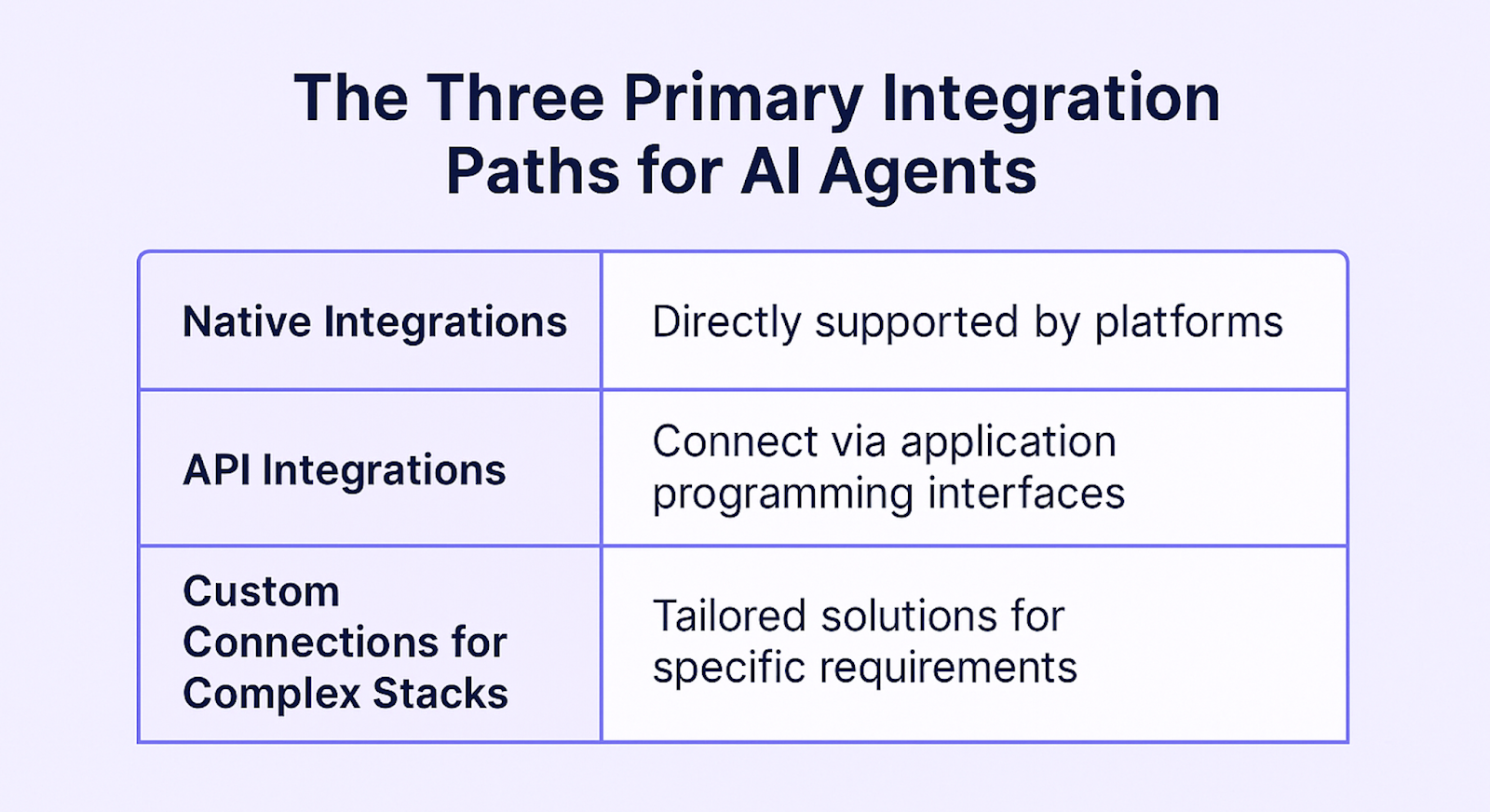
The Three Primary Integration Paths for AI Agents
To work effectively, your AI agent must connect deeply with your existing platforms.
There are three main ways to do that — each with strengths, weaknesses, and best-fit scenarios.
1. Native Integrations — Seamless by Design
What it is:
Pre-built, vendor-supported connections between your AI agent and popular marketing platforms (HubSpot, Salesforce, Shopify, Marketo, Google Ads, etc.).
How it works:
- Go into the AI agent’s settings,
- Select the platform you want to connect,
- Authenticate with your credentials,
- Agent now has secure, real-time read/write access.
Why it’s great:
- Fast and easy setup,
- Minimal technical know-how required,
- Data flows in real time — essential for dynamic decisions.
Case Example:
A SaaS company integrated its AI agent natively with HubSpot and Google Ads. When a lead hit “high intent” scoring in HubSpot, the agent:
- Triggered a hyper-personalized nurture email,
- Created a custom ad audience in Google Ads,
- Allocated budget from low-performing campaigns to the new segment.
The entire sequence ran without human intervention, resulting in a 22% increase in lead-to-opportunity conversion rates.
Watch out for: If no native integration exists for a critical tool, you’ll need API or workflow automation solutions.
2. API Integrations — Custom Connections for Complex Stacks
What it is:
APIs (Application Programming Interfaces) act like universal translators between software. They allow your AI agent to connect with niche, proprietary, or custom-built systems.
How it works:
- Get an API key and documentation from your platform,
- Configure the agent to call or receive calls from the API,
- Build workflows that push/pull data between systems.
Why it’s great:
- Connects to almost any platform with an open API,
- Fully customizable workflows,
- Ideal for advanced data routing and unique business logic.
Case Example:
A global e-commerce retailer used an API integration to connect its AI agent to a custom-built inventory system. The agent:
- Pulled live stock levels,
- Adjusted product recommendations in email campaigns,
- Paused ads for out-of-stock items
Result: 18% reduction in wasted ad spend.
Watch out for:
- Requires development resources
- Needs ongoing maintenance (API updates can break connections)
3. Workflow Automation Tools — No-Code Bridging
What it is:
Platforms like Zapier, Make, or Workato act as “middlemen,” connecting apps that otherwise wouldn’t integrate.
How it works:
- Create workflows based on triggers (“When this happens… do that”),
- Agent receives data or sends actions through the automation platform.
Why it’s great:
- No-code setup for non-technical teams,
- Quick way to prototype or test workflows,
- Bridges gaps between tools without APIs.
Case Example:
A B2B consultancy used Zapier to connect their AI agent to Eventbrite and HubSpot. When someone registered for a webinar, Zapier:
- Sent registrant info to the AI agent,
- Agent personalized a follow-up email based on the topic,
- Added contact to a relevant LinkedIn Ads audience
Watch out for:
- Trigger-based, not true real-time,
- May struggle with high-volume or complex multi-system coordination
The “Before and After” of AI Agent Integration
Before: The Human Hub Model
- Lead enters CRM,
- Marketer exports CSV, uploads to email tool,
- Marketer manually creates social audience,
- Reports pulled from three platforms and combined manually
Problems:
- Hours lost in admin work,
- Slow reaction time,
- Disconnected customer experience.
After: The Agent as Central Brain
- Lead enters CRM → agent scores and tags,
- Agent triggers email nurture in your ESP,
- Agent updates social audience for retargeting,
- Agent sends real-time performance report to sales team.
Results:
- Campaign execution in minutes, not days,
- Personalized, consistent messaging across channels,
- Team time freed for strategy and creativity.
Best Practices for Flawless AI Agent Integration
1. Start Small, Win Fast
Pick one high-impact workflow to integrate first:
- Lead qualification
- Cart abandonment
- Ad budget reallocation
- Content distribution
Show quick ROI to build internal buy-in.
2. Test in a Sandbox
Use a non-live environment to:
- Validate data flows
- Catch errors before they affect customers
- Refine agent instructions
3. Clean Your Data First
Your agent’s intelligence depends on what it’s fed.
- Deduplicate CRM records
- Fix formatting inconsistencies
- Ensure event tracking is accurate
4. Map Your Data Flows
Create a visual integration map showing:
- Data sources
- Trigger points
- Actions taken by the agent
This reduces ambiguity and supports troubleshooting.
Security and Data Privacy: Your Non-Negotiables
An AI agent may handle more sensitive data than any single team member — and regulators are watching.
Your checklist:
- Compliance with GDPR, CCPA, and industry-specific regulations
- Encryption (AES-256 or better) in transit and at rest
- Granular permissions so the agent sees only the data it needs
- Audit logs to track agent actions
Integration Pitfalls to Avoid
- Over-integrating on Day One — leads to complexity and errors
- Ignoring API limits — can throttle performance
- Not planning for failure — build backup workflows
- Forgetting human oversight — always keep the ability to override
The AI Agent Integration Framework
Step
Objective
Actions
1. Goal Definition
Decide what success looks like
Define metrics & KPIs
2. Platform Mapping
Identify all MarTech tools
Create an integration map
3. Method Selection
Pick native/API/automation
Evaluate pros/cons
4. Pilot Workflow
Start with 1–2 integrations
Track quick wins
5. Security Setup
Protect data
Set permissions, encryption
6. Scale & Optimize
Expand integrations
Continuous testing
Future Outlook: The Agent-Driven MarTech Stack
Within 3 years:
- Native AI agent integrations will be standard in major MarTech tools
- Agents will proactively recommend adding or removing platforms based on ROI
- Multi-agent orchestration will allow content, ads, and CRM to work in one self-optimizing loop
Conclusion
Integrating an AI agent isn’t just a technical exercise. it’s a strategic evolution.
Done right, your agent becomes the central brain of your marketing stack:
- Reading from every platform
- Acting instantly across channels
- Learning from every result
The result is not just efficiency; it’s marketing that operates at the speed of opportunity.

.jpg)
.jpg)