
Beyond Automation: Why Your Marketing Team Needs AI Agents, Not Just AI Tools
.jpg)
Identify your target audience
Pretium eget enim ut bibendum ac rutrum hendrerit risus vitae non morbi phasellus sollicitudin luch venenatis tortor massa porttitor diam auctor arcu cursus sit mauris scelerisque orci aliquam amet nascetur lectus tempus nunc tortor sed enim fermentum tincidunt quis erat nibh interdum cum tristique tincidunt cursus malesuada amet ac feugiat aliquam tellus non.
- Donec ornare scelerisque sit ut dictumst sed vulputate amet quam bibendum.
- Varius at malesuada mi aliquet proin eu condimentum aliquam tincidunt ac elit.
- Viverra et et non facilisis congue orci purus feugiat morbi sapien pharetra pellentesqe.
- At a massa ante pharetra ultricies libero enim nulla tristique lacus sed.
Implement lead
Mus mauris donec consectetur nisl ultricies. Malesuada integer augue sed ullamcorper condimentum malesuada mauris vulputate integer. Sit fermentum sit orci sit velit pulvinar sed. Nunc leo sed diam ornare felis magna id vitae urna. Scelerisque gravida eget at pellentesque morbi amet vitae elit volutpat. Pretium in gravida vel nascetur platea dictum parturient laoreet.
Why Identifying Your Target Audience is Key to Success
Sit fermentum sit orci sit velit pulvinar sed. Nunc leo sed diam ornare felis magna id vitae urna. Scelerisque gravida eget at pellentesque morbi amet vitae elit volutpat. Pretium in gravida vel nascetur platea dictum parturient laoreet.
- Elit venenatis suscipit mus nec mauris et purus egestas imperdiet mauris.
- Amet nisl nisl proin praesent orci pellentesque eu egestas eu scelerisque ipsum.
- Viverra nulla id lobortis ut sollicitudin aenean arcu volutpat non suspendisse.
- Volutpat risus ut suscipit nec pretium libero nulla lacus vitae donec facilisis.
Tailoring your message to your target audience
Id integer amet elit dui felis eget nisl mollis in id nunc vulputate vivamus est egestas amet pellentesque eget nisi lacus proin aliquam tempus aliquam ipsum pellentesque aenean nibh netus fringilla blandit dictum suspendisse nisi gravida mattis elementum senectus leo at proin odio rhoncus adipiscing est porttitor venenatis pharetra urna egestas commodo facilisis ut nibh tincidunt mi vivamus sollicitudin nec congue gravida faucibus purus.
“Dignissim ultrices malesuada nullam est volutpat orci enim sed scelerisque et tristique velit semper.”
The role of demographics in identifying your target audience
Id integer amet elit dui felis eget nisl mollis in id nunc vulputate vivamus est egestas amet pellentesque eget nisi lacus proin aliquam tempus aliquam ipsum pellentesque aenean nibh netus fringilla blandit dictum suspendisse nisi gravida mattis elementum senectus leo at proin odio rhoncus adipiscing est porttitor venenatis pharetra urna egestas commodo facilisis ut nibh tincidunt mi vivamus sollicitudin nec congue gravida faucibus purus.
Artificial intelligence in marketing isn’t just a buzzword: it’s a competitive pivot. For years, marketers have leaned on AI-powered tools, content generators, analytics dashboards, ad optimizers. These tools speed up work, but they’re still, at their core, reactive task managers.
That’s like swapping in a high-speed train for your car—but still driving yourself.
The real breakthrough is no longer the pace of it—it’s the autonomy. That’s where AI agents come in: systems that think strategically, act autonomously, coordinate across channels, and adjust in real time. They turn “AI adoption” into “AI advantage.”
What’s the Difference Between an AI Tool and an AI Agent?
Let’s break it down:
- AI Tool
- Reactive and single-function
- Needs human direction for every step
- Like a power drill: efficient but stuck in your hands
- Reactive and single-function
- AI Agent
- Proactive and goal-driven
- Autonomously plans, executes, learns, and adapts
- Like an expert contractor: you define the outcome, they handle execution end-to-end
- Proactive and goal-driven
At-a-Glance Comparison
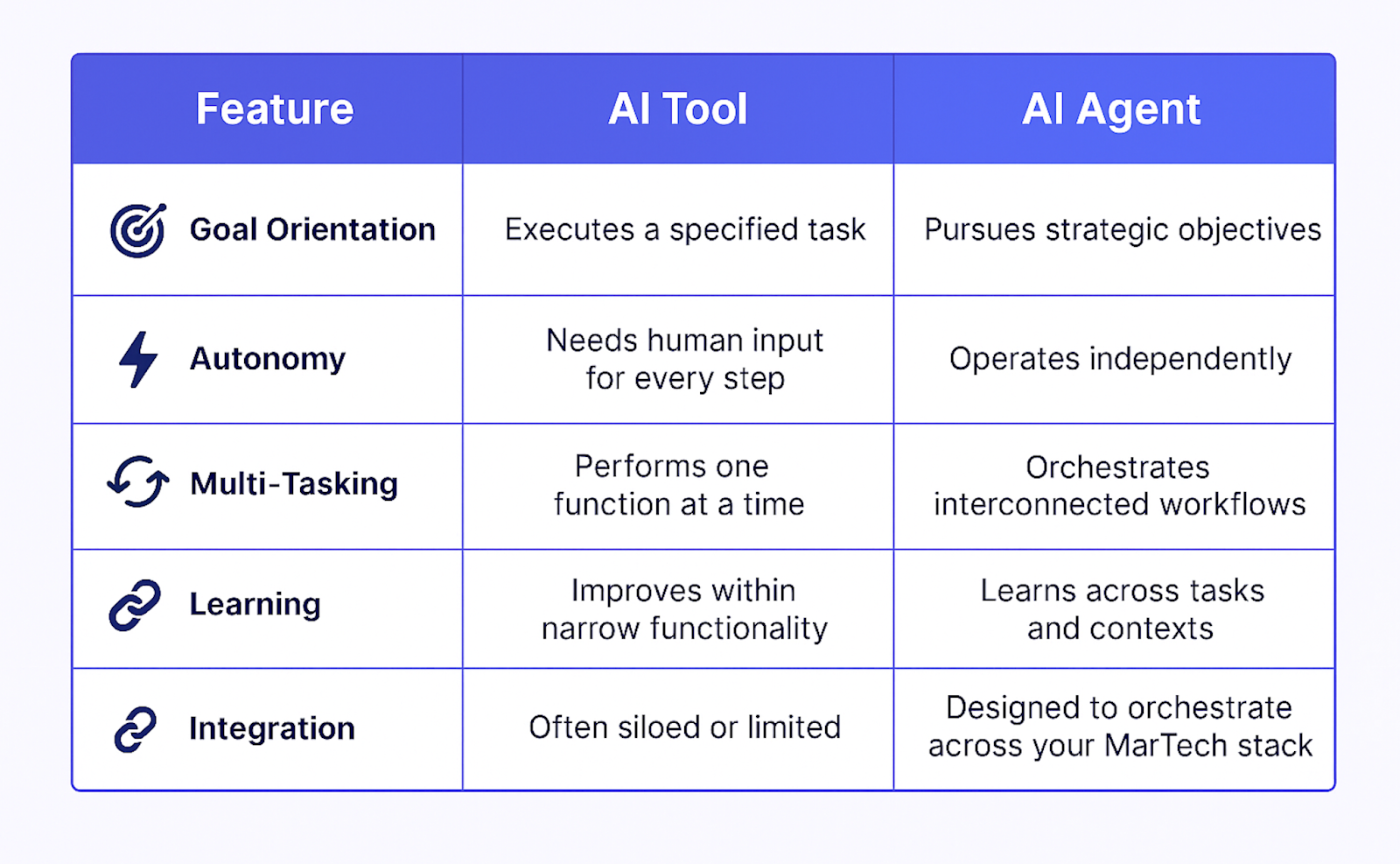
As BCG puts it, AI agents are “intelligent collaborators” that bring decision-making, memory, and environmental awareness to workflows—not just automation.
Real-World Power: How AI Agents Transform Marketing
1. Real-Time Campaign Optimization & Budget Allocation
Demandbase shares how AI agents monitor campaign performance and rebalance budgets across platforms dynamically—for instance, shifting spend from underperforming LinkedIn ads to higher-ROI Google Ads Demandbase. That’s instant ROI improvement without human intervention.
2. Personalized Content & Recommendations
Agents can dynamically surface content or offers based on user behavior. One example: after a user downloads a product comparison, the agent delivers a testimonial video—boosting conversions through behavioral alignment.
3. Enterprise Support & Scalability
It has been reported that a consumer goods company is using intelligent agents to publish blog posts 50× faster and at 95% lower cost.
4. Agent-Led Marketing Campaigns in Action
Adobe unveiled AI agents capable of autonomously creating multilingual ads, optimizing customer journeys, and orchestrating campaign pipelines—working alongside creative teams and infrastructure like Microsoft Copilot.
5. Innovative AI Agent Startups
Auxia, a Palo Alto startup, raised $23.5M to deploy marketing agents that design personalized shopping journeys by parsing customer data across channels.
6. Teams Powered by Agentic AI
Research from Harang Ju & Sinan Aral shows that human-AI teams were 60% more productive, spent 23% more time on creative tasks, and produced higher-performing ad copy—while human-human teams excelled in image quality.
7. Agentic AI: The Bigger Picture
TechRadar frames “Agentic AI” as the next frontier—AI that’s proactive, goal-oriented, and collaborative—paving the way for humans to focus on creativity and judgment while agents handle execution.
8. AI Agents in Marketing Today
Odds are an agent is already powering your customer journey. Bain explains how agents summarize reviews, recommend products, and guide users from vagueness to purchase intent—all by working on behalf of the customer.
9. Widespread Impact & ROI
According to Relevance AI, businesses see 15–30% higher engagement, 20–40% time savings, and 10–25% reduced ad waste when deploying agents.
The Agent-Powered Workflow in Action: A Marketing Scenario
Objective: "Boost Lead Generation by 15% in 90 Days"
Old Workflow (AI Tools):
- Manually research keywords
- Use AI to draft content
- Design creative manually
- Schedule campaigns
- Monitor analytics post-launch
- Human tweaks strategy weekly
Agent Workflow (AI Agent):
- Observe: Scans trends, analytics, and competitor activity
- Plan: Drafts a campaign schedule aligned with target KPIs
- Create: Generates content, visuals, ads
- Publish: Launches posts and campaigns at optimal times
- Adapt: Monitors real-time performance, reallocates budgets, refines messaging
You transition from being a project manager to a Creative Director—setting the vision while your agents manage execution 24/7 with precision.
Why Now? The Case for Immediate Adoption
1. Scalability Without Headcount Expansion
Agents handle infinite workflows at once: emails, ads, content, social engagements—all without overtime or burnout.
2. Strategic Human Focus
Agents free marketers from tedious tasks, allowing them to focus on brand storytelling, strategy, partnerships, and innovation.
3. Real-Time ROI Improvements
Campaign correction happens mid-flight—not weeks later. Your agent recalibrates before budget waste accumulates.
4. Holistic, Integrated Marketing Engine
Forget siloed dashboards and manual handovers. Integrating AI agents create seamless workflows across CRM, email, ads, content, and support—acting as your marketing central nervous system.
5. Measurable Impact
Studies show agents deliver better performance with less effort while generating strategic insights for long-term growth.
If you’re not exploring agennow, your competitors are already building systems that outpace and outsmart tool-driven teams.
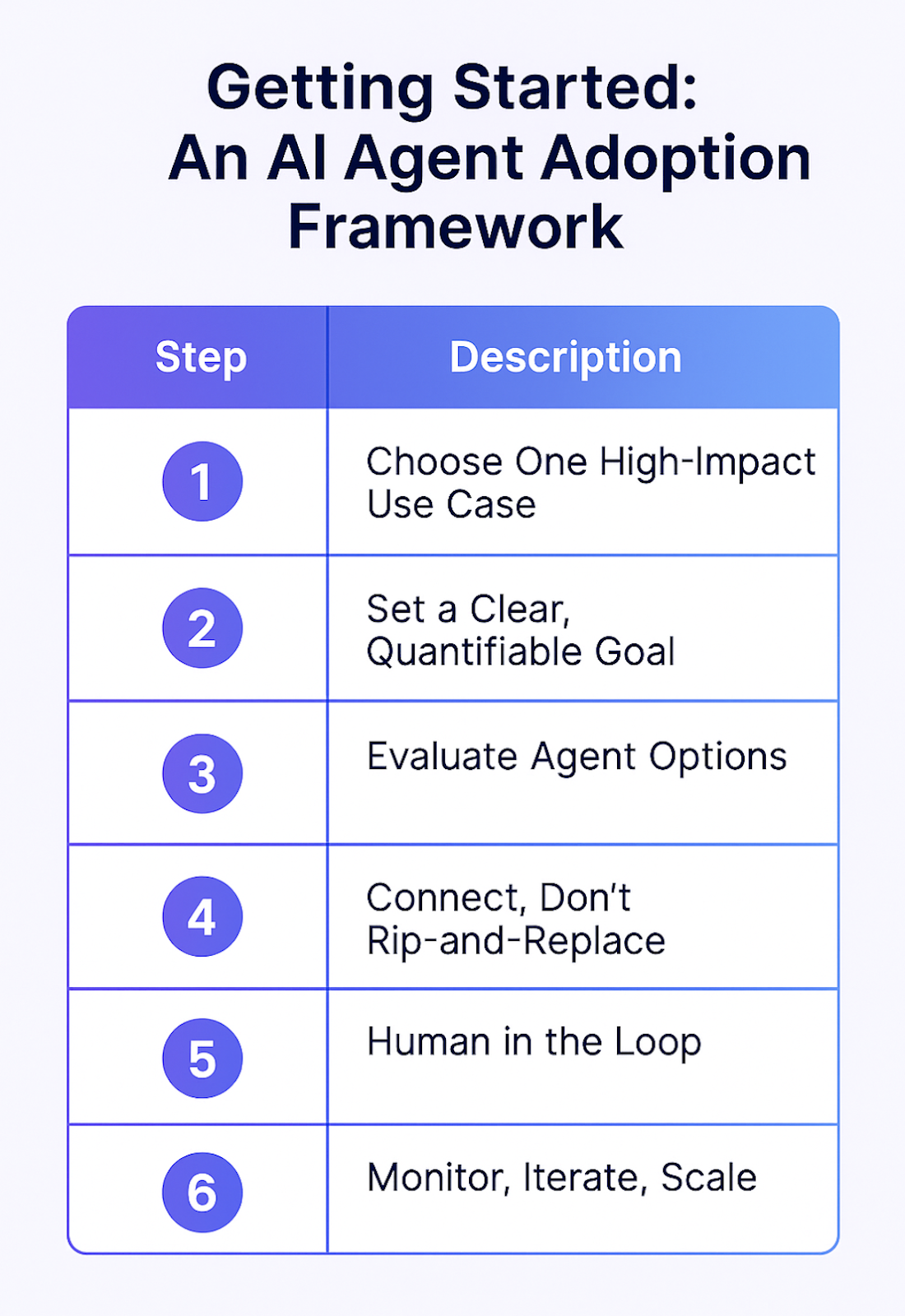
Getting Started: An AI Agent Adoption Framework
Here’s your phased plan to adopt AI agents with ease:
Step 1 – Choose One High-Impact Use Case
Focus on a critical workflow: email personalization, paid ad optimization, social media engagement, or lead qualification.
Step 2 – Set a Clear, Quantifiable Goal
Bad: “More engagement.”
Good: “Increase qualified leads by 15% over 90 days” or “Boost email open rates by 10% month-over-month.”
Step 3 – Evaluate Agent Options
Consider:
- Agent specialization (social vs. content vs. ads)
- Integration capability (CRM, CMS, ad platforms)
- Customization flexibility (white-label vs. bespoke builds)
Platforms like Relevance AI, Omneky, and Lindy offer pre-built or customizable marketing agent frameworks.
Step 4 – Connect, Don't Rip-and-Replace
Your agent should enhance—not replace—existing tools. Ensure seamless APIs with your CRM, CMS, analytics, and ad systems.
Step 5 – Human in the Loop
Start small: let the agent draft, then review. Approve key suggestions. Scale autonomy as trust builds—just like building a relationship with a high-performing teammate.
Step 6 – Monitor, Iterate, Scale
Track performance: engagement, conversions, ROI, productivity. Refine agent prompts, expand its remit to new channels, and continuously improve.
In a nutshell:
Mid-Term Vision: Your Agentic Marketing Organization
1. Content Agent
Generates, schedules, and optimizes blogs, videos, social—all aligned with brand voice.
2. Ad Agent
Runs, tests, and budget-optimizes multichannel campaigns.
3. Email/CRM Agent
Drives segmentation, personalization, and lifecycle campaigns.
4. Analytics Agent
Synthesizes cross-functional data and delivers strategic recommendations.
5. CX Agent
Handles customer inquiries, compliance checks, and messaging across touchpoints.
Your human team? They focus on strategy, creativity, partnerships, and ethical oversight—while agents reliably execute.
Why Agentic Marketing Wins
- Efficiency: Less time on tasks, more time on strategy.
- Performance: Smarter allocation, optimized campaigns, real-time ROI.
- Scalability: Greater output without hiring cycles.
- Human bandwidth: More creativity, less manual labor.
- Strategic edge: Continuous learning through data-driven adaptation.
Pitfalls to Avoid & Ethical Guardrails
Don't Fall into “AI Washing”
Avoid claiming agentic sophistication when you're just running tools. Transparency and capability must align.
Keep Emotional Intelligence in Human Hands
Agents are powerful, but they lack emotional nuance. Final approval, tone, ethics, and brand alignment should stay human-informed.
Watch for Bias and Hallucination
Especially in regulated industries (finance, healthcare), ensure agents are fact-checked and audited.
Invest in Agent Supervision Skills
Managing AI agents becomes a core human skill: training, aligning, and supervising them should be part of your organizational capability development
Real-World Agent Use Cases & Inspiration
Relay.app
Employs an agent to auto-update blog posts and track competitor pricing. Human reviews before publishing ensure quality and brand safety.
Customer Journey Personalization
Auxia uses agents to parse consumer data and deliver hyper-targeted multi-channel experiences—emails, texts, push, and more.
Human-AI Collaboration
Field experiments show:
- 60% higher productivity
- 23% more time spent on creative tasks
- Improved ad copy quality when human-AI teams collaborate.
Final Word: Agents Are Not Optional; They’re Mandated
The marketing arms race has shifted. It’s no longer about whether you’re using AI—it’s about whether you’re deploying AI agents aligned with strategic outcomes.

.jpg)
.jpg)