
Choosing the Right AI Agent: A Marketer’s Buying Guide
Identify your target audience
Pretium eget enim ut bibendum ac rutrum hendrerit risus vitae non morbi phasellus sollicitudin luch venenatis tortor massa porttitor diam auctor arcu cursus sit mauris scelerisque orci aliquam amet nascetur lectus tempus nunc tortor sed enim fermentum tincidunt quis erat nibh interdum cum tristique tincidunt cursus malesuada amet ac feugiat aliquam tellus non.
- Donec ornare scelerisque sit ut dictumst sed vulputate amet quam bibendum.
- Varius at malesuada mi aliquet proin eu condimentum aliquam tincidunt ac elit.
- Viverra et et non facilisis congue orci purus feugiat morbi sapien pharetra pellentesqe.
- At a massa ante pharetra ultricies libero enim nulla tristique lacus sed.
Implement lead
Mus mauris donec consectetur nisl ultricies. Malesuada integer augue sed ullamcorper condimentum malesuada mauris vulputate integer. Sit fermentum sit orci sit velit pulvinar sed. Nunc leo sed diam ornare felis magna id vitae urna. Scelerisque gravida eget at pellentesque morbi amet vitae elit volutpat. Pretium in gravida vel nascetur platea dictum parturient laoreet.
Why Identifying Your Target Audience is Key to Success
Sit fermentum sit orci sit velit pulvinar sed. Nunc leo sed diam ornare felis magna id vitae urna. Scelerisque gravida eget at pellentesque morbi amet vitae elit volutpat. Pretium in gravida vel nascetur platea dictum parturient laoreet.
- Elit venenatis suscipit mus nec mauris et purus egestas imperdiet mauris.
- Amet nisl nisl proin praesent orci pellentesque eu egestas eu scelerisque ipsum.
- Viverra nulla id lobortis ut sollicitudin aenean arcu volutpat non suspendisse.
- Volutpat risus ut suscipit nec pretium libero nulla lacus vitae donec facilisis.
Tailoring your message to your target audience
Id integer amet elit dui felis eget nisl mollis in id nunc vulputate vivamus est egestas amet pellentesque eget nisi lacus proin aliquam tempus aliquam ipsum pellentesque aenean nibh netus fringilla blandit dictum suspendisse nisi gravida mattis elementum senectus leo at proin odio rhoncus adipiscing est porttitor venenatis pharetra urna egestas commodo facilisis ut nibh tincidunt mi vivamus sollicitudin nec congue gravida faucibus purus.
“Dignissim ultrices malesuada nullam est volutpat orci enim sed scelerisque et tristique velit semper.”
The role of demographics in identifying your target audience
Id integer amet elit dui felis eget nisl mollis in id nunc vulputate vivamus est egestas amet pellentesque eget nisi lacus proin aliquam tempus aliquam ipsum pellentesque aenean nibh netus fringilla blandit dictum suspendisse nisi gravida mattis elementum senectus leo at proin odio rhoncus adipiscing est porttitor venenatis pharetra urna egestas commodo facilisis ut nibh tincidunt mi vivamus sollicitudin nec congue gravida faucibus purus.
The marketing world is in the middle of a seismic shift.
We’re moving from AI tools (reactive, task-based assistants) to AI agents (proactive, goal-oriented systems that operate like digital team members).
And the pace is accelerating:
- Gartner predicts that by 2026, 70% of enterprises will use AI agents for at least one core business process.
- BCG reports early adopters are already cutting campaign execution time by 50–70% while increasing ROI by double digits.
For marketers, the implications are clear:
Your choice of AI agent will shape not just campaign results, but your entire team’s productivity, agility, and creative bandwidth.
The problem?
The AI agent market is a gold rush. For every game-changing platform, there are dozens of rebranded chatbots or limited automation scripts masquerading as agents.
Pick wrong, and you risk:
- Fragmented data and broken workflows,
- Off-brand customer experiences,
- Burnt budgets and frustrated teams.
This guide will walk you through how to choose the right AI agent for your marketing needs with a framework you can apply immediately.
Understanding AI Agents in Marketing
Before we talk selection, let’s clarify what an AI agent is and isn’t.
AI Tool vs AI Agent

Example: A social media AI tool writes captions when you prompt it.
A social media AI agent decides the optimal posting schedule, generates copy, designs visuals, monitors performance, and reallocates budget to top-performing content without waiting for you to push buttons.
💡 Key takeaway: Don’t confuse automation with agency. An agent is a strategic collaborator, not a fancier macro.
Step 1: Define Your Goal, Not the Task
Why it matters:
Buying based on “tasks” leads you to narrow tools. Buying based on business goals leads you to agents that deliver measurable outcomes.
Wrong: “We need an AI agent to write our emails.”
Right: “We need an AI agent to increase email click-through rates by 20% over the next 90 days.”
How to define the right goal:
- Identify the root pain point: Low engagement, slow campaign turnaround, poor lead quality, high ad waste.
- Quantify the desired outcome: Add a percentage, time frame, or revenue target.
- Connect to business impact: Make sure the goal moves a KPI that matters.
Case in point:
A B2B SaaS company targeting “write more blog posts” ended up with a content generator that increased quantity but not quality. When they reframed the goal as “increase inbound demo requests by 15%,” they chose an agent that optimized topic selection, CTA placement, and lead capture forms — delivering actual pipeline growth.
💡AgentRush Insight:
Use the SMART goals framework (Specific, Measurable, Achievable, Relevant, Time-bound) before shortlisting agents. This aligns your choice to results, not features.
Step 2: Assess Integration and Environmental Awareness
A great agent doesn’t just act; it connects, understands, and adapts.
Integration questions to ask:
- Does it natively integrate with your CRM (HubSpot, Salesforce), CMS (WordPress, Webflow), ad platforms, and analytics?
- Does it offer a robust API for custom workflows?
- Can it pull in first-party data (CRM, purchase history, site analytics) and third-party enrichment (social listening, market trends)?
Environmental awareness checklist:
- Can it recognize customer lifecycle stages?
- Can it distinguish between new leads and long-term customers?
- Does it adapt tone, offers, and channel mix accordingly?
Case study:
A retail brand used an AI agent that integrated directly with Shopify, Klaviyo, and Facebook Ads. When a customer abandoned a cart, the agent triggered a personalized email, followed by a retargeting ad with a time-limited discount. Result: a 19% lift in recovery rates.
💡AgentRush Insight:
Before committing, map your current marketing workflow with every touchpoint and data source. Use it as a checklist when evaluating integration capabilities.
Step 3: Evaluate Autonomy and Guardrails
Autonomy is the superpower of an agent but without control, it’s a liability.
Three control levers you need:
- Explainability: Can it show why it took an action, with the supporting data?
- Guardrail customization: Can you set budget caps, compliance rules, brand voice guidelines?
- Intervention capability: Can you pause, override, or adjust its decisions in real time?
Think about it like this:
A good agent is like a senior marketing manager, they can run the show, but you still set strategy, budgets, and brand direction.
Test it before buying:
- Give it conflicting instructions.
- Create tight budget constraints.
- Change the goal mid-campaign.
Watch how it adapts, explains, and recovers.
Case study:
An e-commerce brand tested two ad-buying agents. Agent A overspent early without explanation. Agent B stayed within budget caps, reallocated funds from underperforming creatives, and explained the logic behind each change. Guess which one they bought.
Step 4: Consider Scalability, Security, and Support
You’re not just buying for today. You’re investing in an agent that will grow with your needs.
Scalability
- Can it handle both single-market pilots and global campaigns?
- Does it adapt to multi-language, multi-channel environments?
Security & compliance
- GDPR, CCPA, or industry-specific compliance (HIPAA, PCI DSS)?
- Encryption standards (AES-256 or better)?
- Data residency and retention policies?
Support
- Dedicated account managers?
- Onboarding & training resources?
- An active peer community?
Case study:
A fintech startup chose an AI agent partly because its vendor had 24/7 support, GDPR compliance, and a customer Slack community. When a campaign glitch hit on launch day, they had it resolved in under an hour — avoiding revenue loss.
💡AgentRush Insight:
Ask for client references from companies of your size and industry. Their scaling and support experiences will tell you more than any sales pitch.
Bonus: The AI Agent Evaluation Matrix
Evaluation Area
Must-Have Criteria
Questions to Ask
Goal Alignment
Tied to measurable business outcomes
“How does your agent track progress toward my KPIs?”
Integration
Native connections + flexible API
“Which CRMs, CMSs, and ad platforms do you integrate with?”
Autonomy & Guardrails
Explainable, controllable, overridable
“Can I set spend caps and override decisions?”
Scalability
Handles growth in volume, channels, and markets
“What’s the largest campaign your agent has managed?”
Security
Compliance + encryption + data governance
“Where is my data stored, and how is it encrypted?”
Support
Responsive, knowledgeable, accessible
“What’s your average support response time?”
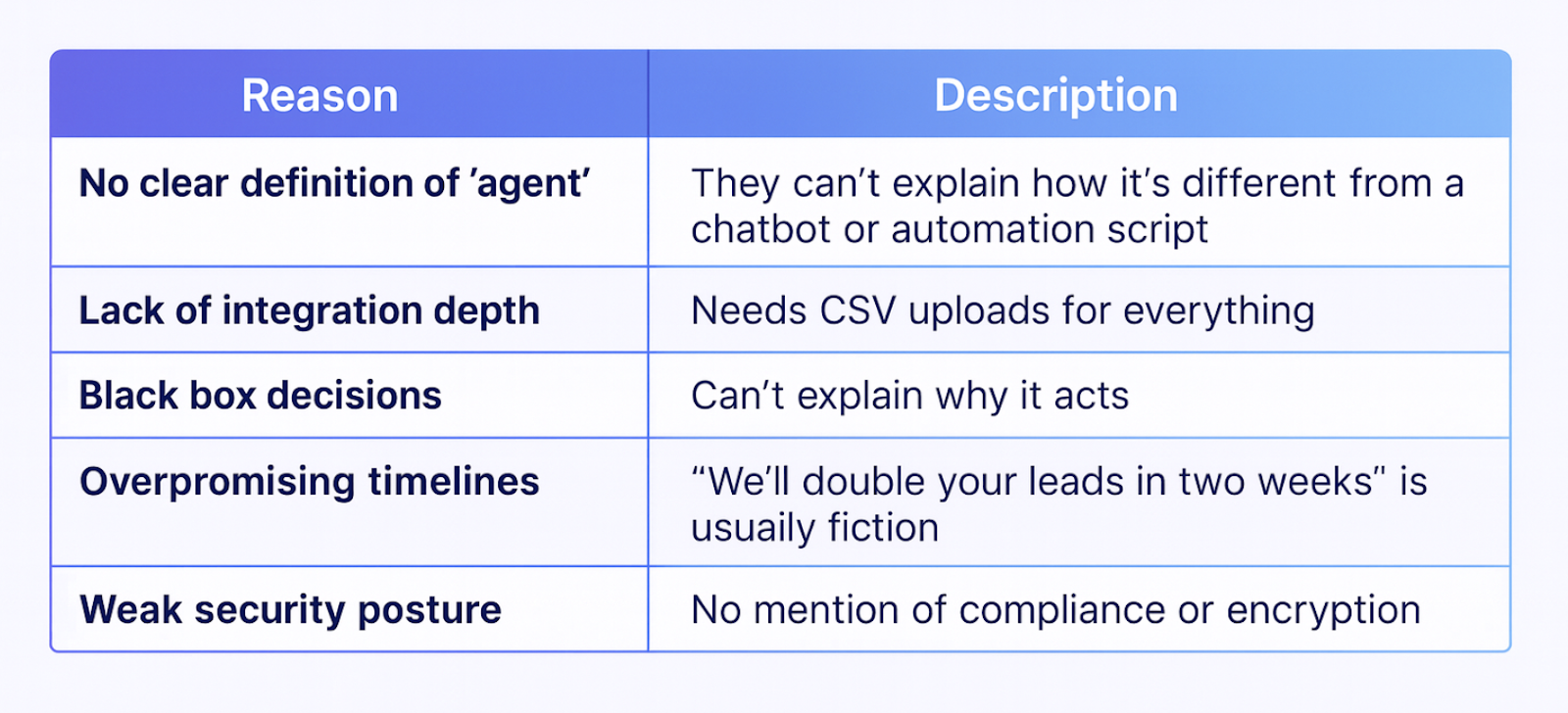
Before making your choice on an AI agent, check out these red flags:
The Future of Agentic Marketing
Within 2–3 years, AI agents will become standard members of marketing teams. The differentiator won’t be whether you have one, it’ll be how intelligently you chose, integrated, and managed it.
Forward-looking companies will:
- Pair agents with humans for hybrid creativity
- Integrate agents across the entire customer journey
- Build internal playbooks for agent supervision and governance
Conclusion
The AI agent you pick today will shape your marketing efficiency, agility, and ROI for years.
Your selection framework:
- Define clear, measurable goals.
- Vet for deep integration and contextual understanding.
- Balance autonomy with human oversight.
- Demand scalability, security, and support.
- Trust but verify with demos, tests, and references.
The most competitive marketing teams in the coming years will have fewer tools, but smarter agents, ones that work toward business objectives, not just task completion.
FAQ about Choosing the Right AI Agent
- What features should marketers look for when evaluating an AI agent?
When you’re choosing an AI agent, the biggest thing to focus on is integration.
Another must-have is human-in-the-loop control. You should be able to review, tweak, and override its decisions instead of letting the AI run blindly.
Finally, make sure it’s scalable and compliant, so it won’t break under pressure or put your data at risk.
- How can AI agents improve marketing ROI and campaign efficiency?
AI agents shine when it comes to speed and scale. They can automatically create, test, and optimize campaigns in real time.
On top of that, they personalize messages for each customer segment while continuously reallocating budget toward what’s working. The result is lower customer acquisition costs and higher ROI without expanding your team.
- How do pricing models for AI agents typically work in marketing platforms?
Most AI agents for marketing follow a SaaS subscription model, where you pay a flat monthly fee for access. Others operate on a usage-based system, charging you based on campaign volume, ad spend managed, or credits consumed.
Some advanced platforms are shifting to performance-based pricing, where you pay a percentage of the revenue generated or savings created.
- What risks or challenges should marketers be aware of before adopting an AI agent?
Handing too much control to AI and losing the creative edge that makes campaigns stand out. Marketers still need to guide strategy, while the AI handles execution and optimization.
Another challenge is messy data and compliance. If your CRM is disorganized or your AI mishandles customer data, the agent can make poor decisions or expose you to legal risk.

.jpg)
.jpg)